

Trust and Psychological Safety: The 3 Values Every Leader Needs
Psychological safety has exploded in the leadership conversation. Google searches for the term have increased dramatically since 2016, with a sharp spike in recent years. Google's Project Aristotle brought it to the spotlight. Amy Edmondson's decades of research built the foundation. It's becoming an essential part of the conversation about high-performing teams, and for good reason. Teams with psychological safety perform better, innovate faster, and retain talent longer.
But here's the gap: knowing why psychological safety matters doesn't tell us how to build it.
There's plenty of advice out there: be vulnerable, encourage feedback, celebrate failure. And sure, those things are important. But they only build trust when they come from something real.
That 'something real' is a set of core values.
Because psychological safety isn't separate from trust. It is trust, in a group context. And trust — whether individual or collective — is built on three specific values: Authenticity, Empathy, and Cogency.
At the individual level, trust is when someone has your best interests at heart, because they’ve consistently demonstrated that they do. At the team level, it's the shared belief that the team has each other's backs: it's safe to take risks, speak up, and make mistakes without fear of embarrassment or punishment.
And when that trust exists, people thrive. They bring their best ideas, flag problems early, take smart risks, and grow. Performance follows as the natural result of genuine care.
So how do we build that foundation of trust?
Anne Morriss and Frances Frei's Trust Triangle gives us the framework. Three pillars form the foundation of trust: Authenticity, Empathy, and Cogency.
Frei and Morriss call this third pillar 'Logic,' but I’ve replaced it with the word ‘Cogency.’ Logic is internal: it's what makes sense in your head. Cogency is relational: it's whether your reasoning makes sense to others.
Together, these three values form the foundation that makes psychological safety possible.
The Three Values of Trust
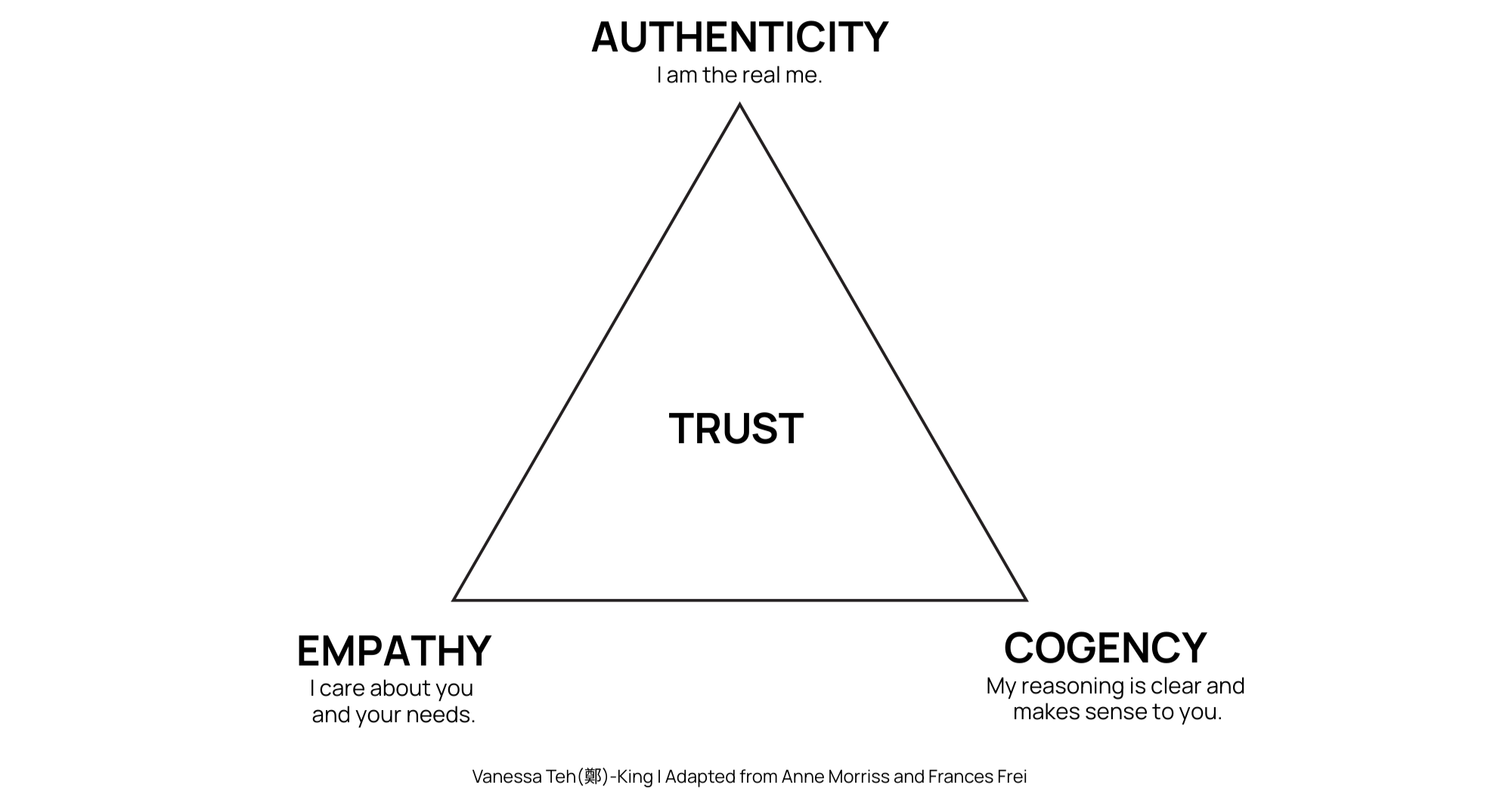
Authenticity: "I am the real me."
Authenticity is where trust begins: it's the alignment between what's true inside you and what you express outwardly. It means being honest with yourself and others, and sharing that truth in a way that's safe, clear, and appropriate for the context.
Authenticity builds trust because it establishes reliability. When there's consistent alignment between what you say and what's true, people know they can count on your honesty every single time. If you're caught in a lie even once, everything else you've ever said comes into question. The stakes are clear: without authenticity, trust doesn’t exist.
In practice, authenticity looks like this: admitting when you've made a mistake, saying "I don't know" when you don't have the answer, and naming how you feel in a way that strengthens connection rather than creates distance.
For example: A leader realises they misunderstood information from senior leadership and relayed it incorrectly to their team. They bring it up immediately: 'I got this wrong, I misheard the timeline in our leadership meeting. Here's what was actually said, and I apologise for the confusion.'"
Here's what it doesn't look like: A leader who presents different versions of themselves to different stakeholders, saying what they think each person wants to hear rather than what they believe is true. For instance: telling their team 'I fought hard for your budget increase but leadership overruled me,' while immediately telling senior leadership that 'I agree the budget needed to be cut.’
Empathy: "I care about you and your needs."
Being honest is essential for trust, but truth alone isn't enough. Without empathy, even honest communication can damage trust rather than build it.
Empathy builds trust because it shows people they genuinely matter to you. It's what makes difficult conversations possible and hard feedback receivable. It’s the bridge that turns honesty into connection. But empathy only works when it's authentic and clearly communicated. Without authenticity, empathy feels performative, and without cogency, your care can be misunderstood or go unnoticed.
In practice, empathy means actively listening and taking genuine interest in people: their ideas, interests, concerns, and experiences. It means noticing when someone is struggling and offering support, making decisions that consider the impact on people, and creating space for others to be heard even when you disagree.
Here's what it looks like: A leader notices someone's been quieter than usual in meetings. They decide to check in privately: "I've noticed you’ve been a little more quiet than usual lately. Is everything okay? Is there anything I can do to help?”
Here's what it doesn't look like: A leader who announces a major process change without consulting those affected or considering the impact on their workloads, then seems genuinely confused when implementation stalls and people resist the change.
Empathy shows people that they matter. Without it, trust doesn’t exist.
Cogency: “My reasoning is clear and makes sense to you.”
You can be both honest and empathetic, but if your reasoning doesn't land clearly, trust will still break down. That's where cogency comes in.
Cogency isn't just about having sound logic: it's about whether your reasoning makes sense to others. Even the best reasoning fails to build trust when people can't follow your thinking or understand how you arrived at your decision.
Cogency builds trust because it allows people to understand the 'why' behind decisions. When your reasoning is clear, people can evaluate your thinking for themselves. Cogency also creates accountability. Knowing you'll need to explain your reasoning forces you to think more carefully, question your assumptions, and make more deliberate choices.
Here's what it looks like: A leader explains why they're delaying a product launch: “We're three weeks from launch, but QA found critical bugs that affect core functionality. We considered pushing through and patching post-launch, but that would damage user trust and create support burden. So we're delaying the launch by a month. The tradeoff is missing our revenue target this quarter, but we're protecting long-term credibility and avoiding a support crisis that would impact the entire team."
Here's what it doesn't look like: A leader sends an email saying “After careful consideration, we will be pausing the Q4 initiative indefinitely,” with no explanation of what factors were considered, what alternatives were explored, or what team members should work on now. Everyone is left guessing whether it's a budget cut, a performance issue, or if their roles are at risk.
Why All Three Matter
Each value plays a critical role in building trust. But understanding them individually isn't enough — they must be applied consistently.
Building trust is a continuous practice. Every conversation, every decision, every interaction is an opportunity to ask yourself:
Am I being truthful? (Authenticity)
Do I genuinely care about how this affects people? (Empathy)
Will others understand my reasoning? (Cogency)
No one gets it right all the time. You'll slip. You’ll contradict yourself. You'll act from fear instead of staying aligned with these values.
Sometimes, you’ll be honest but too harsh. Sometimes, you will feel care, but fail to communicate it clearly. Sometimes, you might focus so much on being diplomatic that you're not actually being truthful.
What matters is what you do next.
If you've been too harsh, pause. Ask yourself what you might be missing about their perspective. Ask questions to truly understand it. Allow yourself to sit with whatever discomfort or emotions you've been avoiding about their experience.
If your reasoning wasn't clear, slow down. Do you actually understand your own decision? Map out the situation, the options you genuinely considered, and what tradeoffs you're accepting. If you haven't considered alternatives, ask yourself why: is it urgency? Limited resources? Fear? Whatever the reason, you need to be able to explain it to others in context.
If you weren't being truthful, be honest with yourself about what you're avoiding. What do you believe it will cost you to tell the truth? Then find a way to say what needs to be said — as clearly and safely as possible.
This is the work — and it’s ongoing. Each conversation, each decision is another opportunity to build trust.
It's a continuous practice you commit to, and through that practice, Authenticity, Empathy, and Cogency transform from principles into the foundation of psychological safety.
To scale that foundation across an organisation, you’ll need systems that protect and enable these values for everyone. In my next article, I'll explore those systems — the 3Rs: Rights, Rules, and Resources.